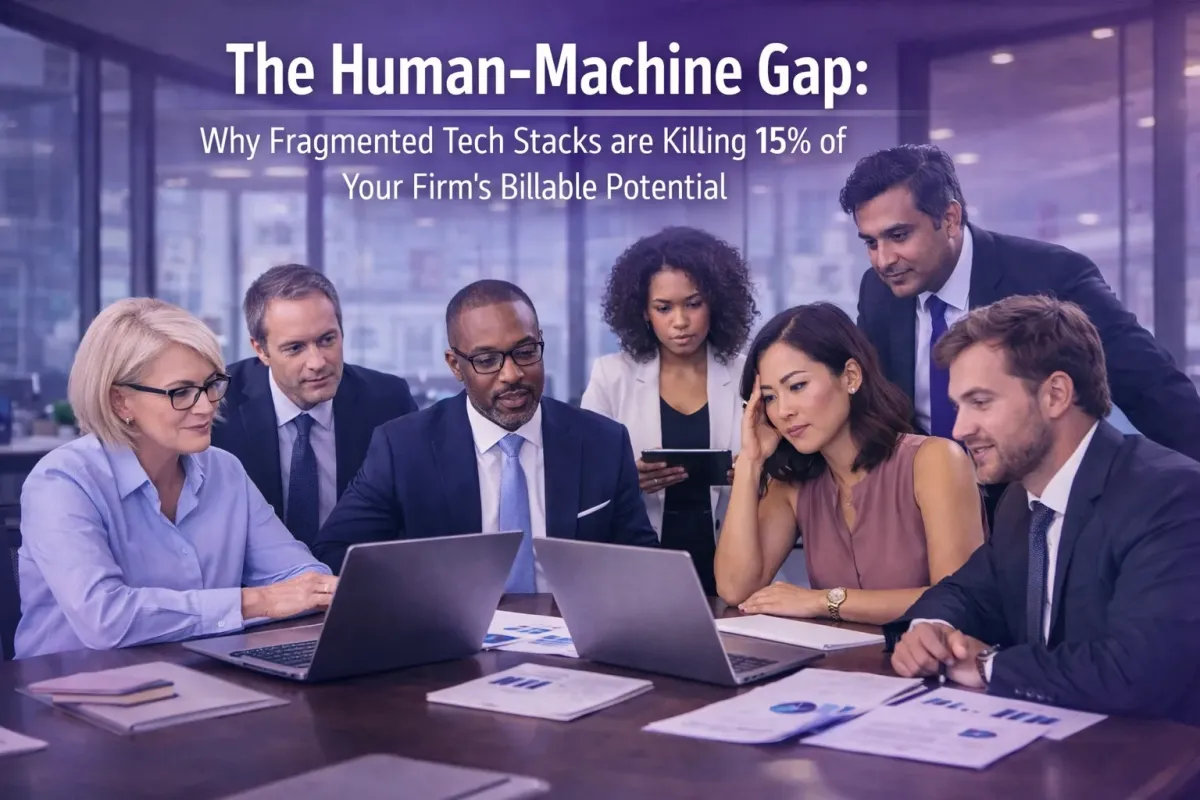
The Human-Machine Gap: Why Fragmented Tech Stacks are Killing 15% of Your Firm’s Billable Potential
The Human-Machine Gap:
Why Fragmented Tech Stacks are Killing 15% of Your Firm’s Billable Potential
![[HERO] The Human-Machine Gap: Why Fragmented Tech Stacks are Killing 15% of Your Firm’s Billable Potential](https://cdn.marblism.com/uprpg138pIZ.webp "[HERO] The Human-Machine Gap: Why Fragmented Tech Stacks are Killing 15% of Your Firm’s Billable Potential")
Ever feel like you’re paying your smartest people to be highly overqualified data entry clerks?
If you’re running a firm with 10 to 50 employees, you’ve likely noticed a weird paradox. You keep buying software to make things "faster," but your team seems more stressed, and your billable hours aren't scaling with your headcount. In the world of Industrial-Organizational (I-O) Psychology, we call this the Human-Machine Gap.
It’s the friction between your team’s biological capacity for deep, focused work and a digital environment that looks like a bowl of "Software Spaghetti." This isn't just a tech headache; it’s a silent predator eating roughly 15% of your firm’s billable potential every single day.
1. The Anatomy of "Software Spaghetti"
When you started your firm, things were simple. You had a spreadsheet and maybe a basic CRM. But as you grew, you added a project management tool. Then a messaging app. Then another for scheduling. Then a separate billing system because the first one didn't handle retainer models well.
By the time you hit 30 employees, you aren't running a streamlined business; you’re managing a digital Frankenstein.

This fragmented stack creates a "swivel-chair" workflow. Data is trapped in silos. Your sales data doesn't talk to your project data, and your project data is a total stranger to your billing system. This forces your high-level talent: your strategists, consultants, and lawyers: to act as the "human API." They spend hours manually moving information between systems, cross-referencing tabs, and chasing down updates.
Recent reports from Goldman Sachs and Bloomberg emphasize that the next wave of corporate productivity won't come from more tools, but from integrated ecosystems. If your people are the ones bridging the gaps between your software, you aren’t leveraging technology; you’re subsidizing its inefficiency with your payroll.
2. The Psychological Cost: The "Toggle Tax"
As an I-O Psychologist, I look at your tech stack through the lens of Cognitive Load. Every time an employee has to switch from a deep-work task: like drafting a complex strategy or analyzing a market trend: to check a notification in a disconnected app, they pay a "Toggle Tax."
Research highlights three major psychological drains:
Attention Residue: According to research popularized by the Harvard Business Review, the average digital worker toggles between different applications nearly 1,200 times per day. When you switch from Task A to Task B, part of your brain stays stuck on Task A. This "residue" reduces your cognitive capacity for the new task.
The Reorientation Penalty: It can take up to 20 minutes to regain full focus after a minor digital distraction. If your team is constantly jumping between a CRM, a separate email marketing tool, and a project board, they never actually reach a "Flow State."
Burnout and Digital Fatigue: Constant context-switching keeps the brain in a "high-beta" frequency: a state of high-alert stress. This is why your team feels exhausted by 3:00 PM even if they haven't "done" much billable work. They’re exhausted from the mental gymnastics of navigating a fragmented stack.

3. Quantifying the Leak: The 15% Billable Deficit
Let’s talk numbers, because that’s what keeps the lights on. If your firm is losing 9% of the workday to the physical act of app-switching and another 6% to errors, "attention residue," and the general mental friction of disconnected systems, you are operating with 15% less capacity than your payroll suggests.
Let’s do some quick math for a 20-person firm:
Average Billable Rate: $200/hr
15% Loss: 1.2 hours per day, per employee.
Annual Impact: Across 20 people, that is over $1.2 million in lost potential revenue annually.
You aren’t losing this money because your competitors are better than you. You aren’t losing it because your team is lazy. You’re losing it to your browser tabs. In a market where Nasdaq-listed giants are obsessing over "operational alpha," smaller firms can't afford to let seven figures slip through the cracks of a messy tech stack.

4. The Solution: Elite Organizational Engineering
At Nobody Greater Inc., we don't believe the answer is "more tools." In fact, we usually find that the answer is fewer tools that do more work. We approach this through Organizational Engineering: aligning your digital infrastructure with the biological reality of how humans actually produce high-value work.
We move firms away from "Software Spaghetti" and toward a Unified Ecosystem based on three pillars:
Consolidation: We ruthlessly eliminate the "15+ subscription" model. If you have five tools to do one job, you have four too many.
Automation of the Mundane: If a human is doing it twice, a machine should be doing it forever. We remove the manual data-transfer tasks that cause cognitive friction.
Human-Centric Design: We build workflows that protect the "Flow State." We prioritize systems that allow your team to stay in one environment to complete a full cycle of work, rather than chasing notifications across the internet.
5. The NBG Pro Suite: Your All-in-One Engine
We saw this gap happening so often with our clients that we had to build a solution for it. The NBG Pro Suite was engineered specifically to close the Human-Machine Gap.
We didn't just build another tool; we built a powerhouse platform that consolidates your CRM, Funnels, Email Marketing, Appointment Scheduling, and Pipeline Management into a single source of truth. By housing your entire client journey: from the first click on an ad to the final invoice: in one place, we eliminate the "Toggle Tax" at the source.
When your team spends less time fighting their tools, they spend more time:
Innovating for your clients.
Strategizing for growth.
Billing hours that actually move the needle.
This isn't just about "efficiency." It's about creating a culture where people can actually do the work they were hired to do.
Conclusion: Reclaim Your Bandwidth
The firms that will dominate the next few years aren't those with the most technology. They are the ones with the most integrated technology. You cannot scale a world-class firm on a foundation of digital chaos.
As we look at current trends in Goldman Sachs’ productivity reports and the shifts in how Essence-leading brands manage their human capital, it’s clear: the "Human API" model is dead. You need an engine that supports your people, not one that depletes them.
Are you ready to stop the 15% leak?
It’s time to audit your infrastructure and engineer a system that supports your human capital. Let’s stop losing $1.2 million to browser tabs and start building an organization that thrives.
Consult with the Nobody Greater team to see how the NBG Pro Suite can unify your operations and unlock your firm's true potential.
Our mission is to help your organization not just compete but thrive within the innovative global force. We believe that by understanding the intricate dynamics of your workforce, we can architect a future of sustained growth, unparalleled innovation, and a culture that attracts and retains the best talent.

Dr. Anika Wilson, PhD, PHR, CDMP
Founding Partner, Organizational Engineering, Nobody Greater Inc.
Contact: [email protected]
